


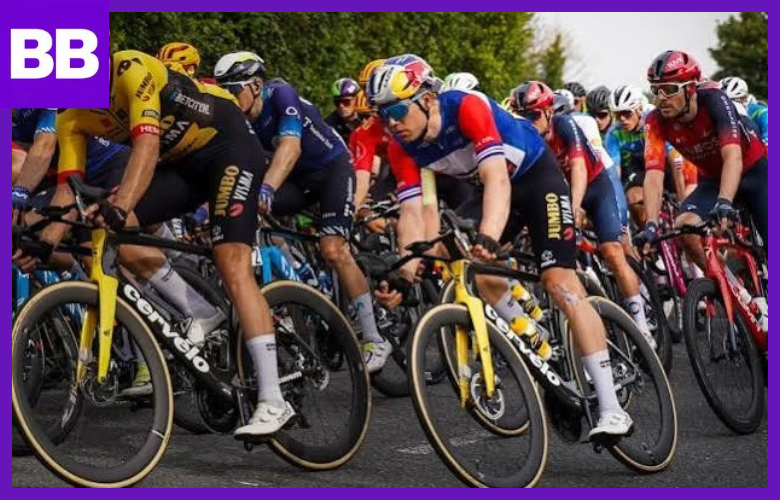
Tim Wellens won the 2026 Tour of Britain without winning a single stage. The 35-year-old took the race lead on the hilly fourth day in Yorkshire, held it through a finale in the Scottish Borders and finished 42 seconds clear of Lewis Askey.
A few weeks earlier, the women’s race had gone to Kim Le Court-Pienaar, who won one stage and still beat Lorena Wiebes, a rider who won four. Both results say something about how stage racing works. They also sit on top of a much older story, one that starts with a wartime row over whether British riders were allowed to race on the road at all.
Tour of Britain at a glance
| Information | Details |
|---|---|
| First edition | 1945 (the Victory Cycling Marathon) |
| Modern version | since 2004 |
| Men’s category | UCI ProSeries |
| Women’s race | started in 2014, in the Women’s WorldTour since 2016 |
| 2026 winners | Tim Wellens (men), Kim Le Court-Pienaar (women) |
How the men’s Tour of Britain played out
This was the 22nd edition of the modern race, a UCI ProSeries event run over five days with roughly 8,800 metres of climbing. It opened in Lincoln on 2 September with a Classics-style loop of 182.5 kilometres that finished up the cobbled Michaelgate climb. Askey, riding for NSN Cycling, won it from the front and pulled on the leader’s jersey.
Stage two, from Boston to Skegness, was messier. The peloton split in two about 60 kilometres from the finish, and Tim Merlier won the sprint from a reduced bunch while Askey stayed out of trouble and kept the lead. The first two stages stayed entirely inside Lincolnshire, and the race passed through Louth for the first time. Olav Kooij answered Merlier on stage three, winning in Beverley after 194 kilometres from Hull. Askey was still leading, but the flat days were running out.
Stage four, from Helmsley to Leyburn, packed in almost 2,700 metres of climbing. Cees Bol took the stage win. The man who mattered was second on the day: Wellens, who moved into the overall lead and did not give it back. The last day was a loop around Earlston. It went to Nils Politt, Wellens’ teammate at UAE Team Emirates-XRG, who won the stage.
Behind him, Wellens closed out the race. Askey was second at 42 seconds and Jasper Stuyven third at 1:03, with Daan Hoole and Rick Pluimers completing the top five. Wellens takes over from Romain Grégoire, the 2025 winner.
Lewis Askey and the British side of the Tour of Britain
Askey, who is 25, was the story of the opening days. He won stage one up the cobbles at Lincoln, kept the leader’s jersey through the sprint finishes in Skegness and Beverley, and wore it for three days before the Yorkshire hills took it away. Only two riders led the race all week: Askey, then Wellens.
He still finished second overall, ahead of Stuyven, which makes him the best-placed British rider on the final classification.
Five stages, five winners
It was that kind of Tour of Britain: five stages, five different winners. Askey took the opener, Merlier the second, Kooij the third, Bol the fourth and Politt the fifth. Merlier and Kooij were level on 43 points in the points classification after trading sprint wins.
The climbing came late. Only the last two stages were rated as hilly, with 2,699 and 2,236 metres of climbing, and that was where the general classification was settled. The sprinters who dominated the first half of the week did not make the podium.
The women’s Tour of Britain: one attack was enough
The women’s race ran from 19 to 23 August as part of the Women’s WorldTour. It went back to five stages after two shorter editions, starting in Cockermouth and finishing in Royal Leamington Spa. On paper it looked like Wiebes’ week. The SD Worx-Protime sprinter won stage one in Cockermouth, then stage two from Clitheroe to Blackpool, a rainy day that was stopped for around half an hour because of an unrelated rescue on the route.
Stage three changed the picture. The short 104-kilometre run from Mold finished on the Great Orme in North Wales, and Le Court-Pienaar, who rides for AG Insurance-Soudal and comes from Mauritius, attacked on the final climb and won alone. She took the leader’s jersey with it. Wiebes won again at Hay-on-Wye on stage four, after a day when Fleur Moors had threatened to reshape the standings with a long solo attack. It was not enough.
On the final day, Wiebes won her fourth stage in Leamington Spa, but Le Court-Pienaar won the overall by 19 seconds, with Liane Lippert third. Lotte Kopecky, the 2024 winner, had withdrawn from the race. The women’s race has its own history. Marianne Vos won the first Women’s Tour in 2014, and later winners include Lizzie Deignan (2016 and 2019), Kasia Niewiadoma, Demi Vollering and Elisa Longo Borghini.
It was cancelled in 2023 because of rising costs and a lack of sponsorship, then returned in 2024 under the Tour of Britain Women name once British Cycling took over its organisation. Ally Wollaston won in 2025.
Where the Tour of Britain came from
The first multi-day road race in Britain was the Southern Grand Prix in Kent in August 1944, won by Les Plume of Manchester. It mattered because of what came before. The National Cyclists’ Union had pushed British racing onto tracks and time trials back in 1890, and a younger generation of riders, cut off from what was happening on the Continent, formed the British League of Racing Cyclists to fight the ban.
A year after the Kent race came the Victory Cycling Marathon, staged to mark the end of the war and won by the Frenchman Robert Batot. Then came a newspaper deal: the Daily Express sponsored a Tour of Britain from 1951, which helped bring road racing back into the mainstream. That arrangement eventually fell apart amid arguments between rival cycling bodies.
What replaced it became the best-known name in British cycling. A semi-pro from Derby, Dave Orford, suggested that the Milk Marketing Board pay to put its slogan on racers’ jerseys, and in 1958 the Milk Race was born. It lasted 35 years, finished with a win for Chris Lillywhite in 1993, and opened to professionals from 1985. Plenty of older fans still call the national tour by that name.
Alongside it ran the professional Kellogg’s Tour of Britain, for eight editions between 1987 and 1994, and later the PruTour, which ended in 1999. After a gap, the modern Tour of Britain arrived in 2004 with a five-day race. Today’s route, five days again, is a nice echo of that first modern edition.
Past winners and what the record book says
No rider has won the Tour of Britain three times across all its versions. Eight have won twice, among them Bill Bradley, Les West, Phil Anderson, Edvald Boasson Hagen and Lars Boom. Bradley is the only one to win in consecutive years, taking the Milk Race in 1959 and 1960.
The recent men’s winners read like a who’s who of the road calendar:
- 2018: Julian Alaphilippe
- 2019: Mathieu van der Poel
- 2021 and 2023: Wout van Aert
- 2022: Gonzalo Serrano
- 2024: Stephen Williams
- 2025: Romain Grégoire, ahead of Remco Evenepoel
- 2026: Tim Wellens
The route usually mixes flat and hilly stages with the occasional time trial, and the length has shifted over the years: the 2025 race covered about 886 kilometres over six stages, while this year’s was a tighter five-day affair. The 2020 race was cancelled.
Williams’ victory in 2024 was the first British overall win since Steve Cummings in 2016, and Askey’s second place this year keeps a British name near the top of the list.
Why this Tour of Britain is worth remembering
Neither winner took the obvious route. Wellens collected no stage and still won, by taking the lead on the one day with real climbing and holding it. Le Court-Pienaar won a single stage, on the Great Orme, and that was all she needed.
For a race that has changed names, sponsors and formats so many times, it is fitting that the Tour of Britain keeps producing results that look unlikely on paper and sensible in hindsight.

3 Comments
Pingback: West End Shows for Kids: What to Book This Autumn and Christmas
Pingback: Halloween Costume Ideas for 2026: Borrow the Trend, Change the Angle
Pingback: Guy Willison: The Despatch Rider Who Turned a Call Sign Into a Motorcycle Brand