


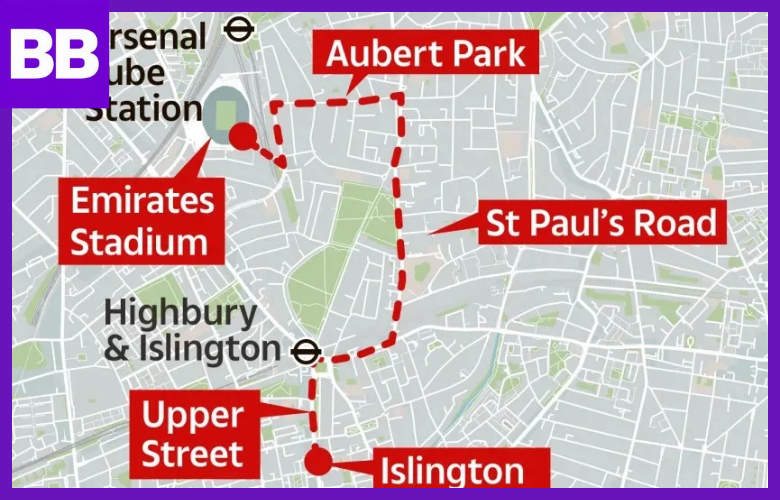
Eighteen hours and fifteen minutes. That was the gap between Gabriel’s missed penalty in Budapest and Martin Odegaard walking out with the Premier League trophy at the Emirates. The parade got underway at 2.15 pm and wound through Islington for about two hours. Few supporters expected to be cheering through a European hangover, yet the Arsenal parade route turned into one of the biggest street gatherings north London has seen. Here is where the buses went, how the day was organised, what the crowd looked like, and what we know and don’t know about the numbers.
Quick facts
| Information | Detail |
|---|---|
| Event | Arsenal’s Premier League title parade |
| Date | Sunday 31 May 2026 |
| Starting point | Emirates Stadium, Islington |
| Scheduled departure | About 2 pm, with four open-top buses |
| Length | Reported as roughly five to 5.6 miles (around eight kilometres) |
| Occasion | The club’s first league title in 22 years, confirmed on 19 May when Manchester City drew at Bournemouth |
| Cost | Free for all fans |
Where the Arsenal parade route actually went
The parade began at the Emirates and followed a loop of around five miles through Islington. One measurement put it a little longer, at 5.6 miles, starting and finishing at the stadium. That gap is probably down to how each count handled the start and finish, so “about five and a half miles” is a fair summary.
The streets named in the club’s briefing for the media were Petherton Road, Beresford Road and Newington Green Road, before the buses turned south down Essex Road. On the day, crowds lined streets including Holloway Road and Upper Street. One pre-event report also listed Seven Sisters Road, Blackstock Road and Green Lanes as part of the circuit. I could not confirm that against a second source, so check it against the club’s official map if you need exact street names.
Highbury Fields sits inside the loop and was expected to draw some of the biggest crowds, with certain areas closed to pedestrians and the buses not visible from them. The advice was to pick a spot on the actual route instead.
The buses and the order of the day
There were several open-top buses, carrying players, coaching staff, the women’s team and community representatives, with a music truck leading the way. The club said the last bus would be a celebration of its community, featuring Arsenal in the Community supporters and staff nominated by their colleagues.
If you were hoping for the trophy to be hoisted at every corner, that wasn’t the plan. The buses moved continuously with no public trophy lift along the route, so the experience was meant to be similar wherever you stood. Arsenal also told fans that fireworks were banned along the route. One outlet reported red flares anyway, though I only found that in a single source.
Getting there: stations and road closures
Transport was a big part of the planning. Arsenal, Holloway Road and Highbury & Islington stations were due to be closed, with TfL pointing fans towards Finsbury Park. Roads along the route and the side streets leading to it were closed, with parking suspended. The event was run with Islington Council, the police, TfL and the emergency services.
The security backdrop was hard to ignore. The previous year, a driver had ploughed a car into the crowd at Liverpool’s parade, injuring 134 people. That is why road closures, crowd control and clear messaging got so much attention before this one.
How big was the crowd?
Bigger than almost anyone predicted. Early estimates put the turnout between 750,000 and one million people. Some outlets went further and claimed 1.5 million, but those figures looked like loose round numbers, not counts, so I would not repeat them as fact. Crowd sizes at parades are always rough estimates.
The numbers did cause problems. Emergency services had to rescue about 75 people stuck on lamp posts and other high vantage points. It is a reminder that a good view is not worth a climb.
A bittersweet day
The mood is what made this parade different. The party took place less than 24 hours after Arsenal lost to Paris Saint-Germain on penalties in the Champions League final. The scheduling was not a choice. Many Arsenal players were in World Cup squads and had to be released to their countries by 1 June, so the parade could not move to a later date.
Fans mostly took the double that wasn’t in stride. One supporter told reporters he would have chosen the league over the Champions League if offered only one, and a 36-year-old Uber driver said the league win felt like a good start for Europe next season.
The 2014 route, for comparison
Arsenal’s last big parade was for the FA Cup in 2014, and the contrast is striking. That route started at Drayton Park by Martineau Road and ran along Aubert Park, Highbury Park, Highbury Grove and St Paul’s Road into Upper Street, ending at Islington Town Hall. Two open-top buses made the trip, followed by a closed reception and a return to the stadium.
The 2026 loop is longer, uses more buses, involves the women’s team, and was planned around a crowd that nobody in 2014 would have had to think about. The Upper Street stretch is the one thing both parades share.
Tips if there is another parade
Parades like this tend to follow a pattern, so a few lessons from this one apply next time:
- Choose your spot early. Crowds were heavy hours before the buses left, and parts of the route clogged up well ahead of time.
- Use Finsbury Park. It was TfL’s recommended station on the day.
- Avoid the pinch points. Highbury Fields and the area around Highbury & Islington were flagged as likely crush spots.
- Stay off lamp posts and bus shelters. The rescue figures speak for themselves.
- Check the official route. The club’s published map outranks any article, this one included.
Conclusion
The Arsenal parade route was a simple idea, a loop around Islington starting and ending at the Emirates, but it became something much bigger because of the day it landed on. A title after 22 years, a Champions League final lost the night before, and a crowd that may have approached a million all came together on the same five-and-a-half miles. If you want a one-line summary of the route, it is the Emirates, Holloway Road, Upper Street, Essex Road and back. If you want the feeling of it, ask someone who was standing on Upper Street at half past two.
Why This Parade Will Be Remembered
Beyond the streets and the numbers, the 2026 parade stood out for what it closed off. Arsenal had finished as league runners-up in each of the previous three seasons, so this was a title earned the hard way. Teenager Myles Lewis-Skelly was not even born the last time the club won the league, in 2004, which tells you how long a generation of supporters had waited.
On the buses, the mood was lighter than the night before suggested. Arteta smiled broadly and waved to the crowds, while Declan Rice told supporters the team would be coming back for more. For many fans, that mix of joy and unfinished business is what the Arsenal parade route will come to mean.

2 Comments
Pingback: Lee Juggurnauth: From Unpaid Intern to Presenter of Other People’s Dream Homes
Pingback: Guy Willison: The Despatch Rider Who Turned a Call Sign Into a Motorcycle Brand